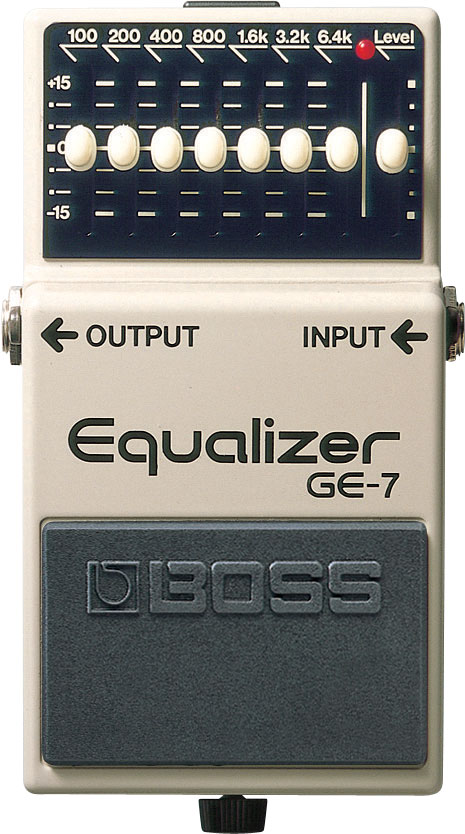
An Equalizer (
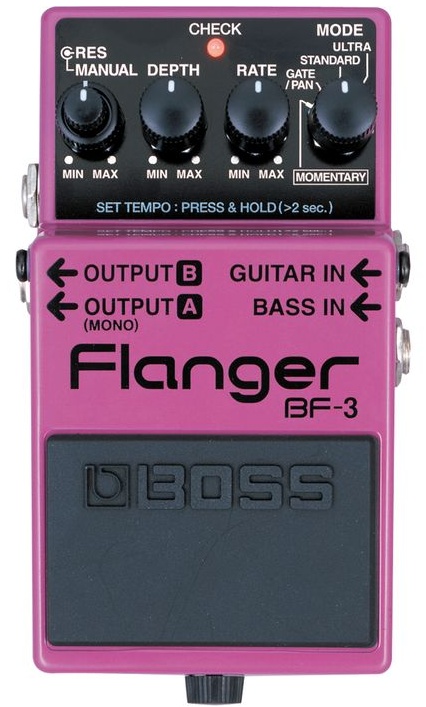
A Flanger (fl?n?r) is an effect designed to produces a unique sound that is both harmonic and discordant at once. The effect is created by playing two identical sounds at the same time, and then slowly delaying one of them in gradually increasing increments. The flanger unit itself can be a dedicated piece of hardware designed specifically for this type of signal processing, but it
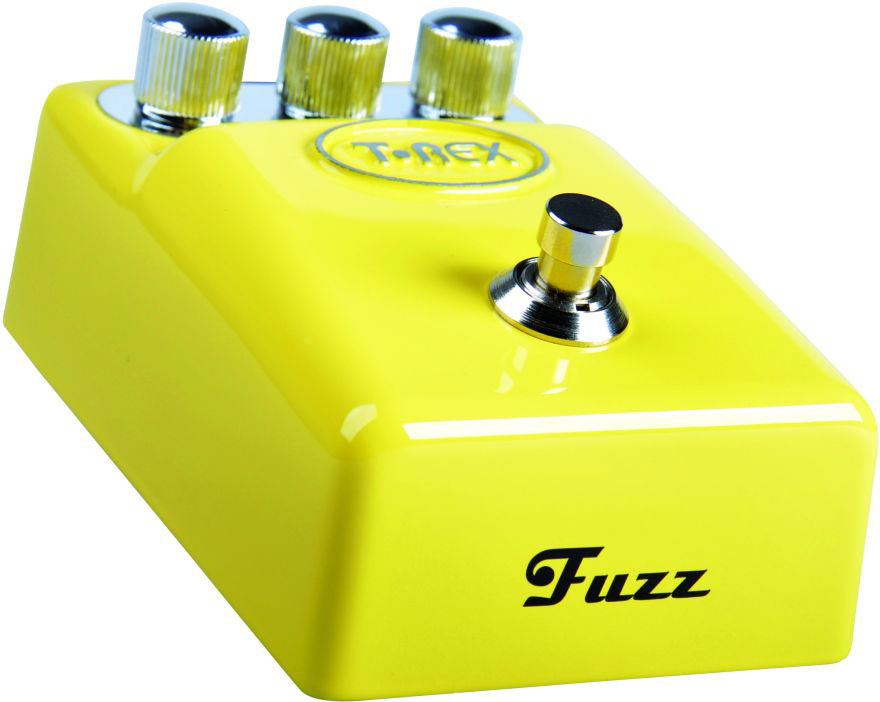
Fuzz (f??z) is one of the oldest and most iconic distortion devices available for the electric guitar. Creating fuzz tones involves boosting the amplitude of the sound waves from a guitar to the point that they are read as square waves on an oscilloscope. Soundwise, fuzz creates a buzzy, singing sustained sound with lots of overtones that still responds to a player’s picking dynamics.
Fuzz is a very common effect used in classic rock, but is still popular with contemporary players. In the past, fuzz was produced by slitting the speaker cones with a razor. However, fuzz tones are now available from a very wide menu of pedal, or stompbox choices.
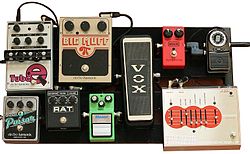
Guitar Effects (g?t??r ?f??kts) are devices used to enable a guitar player to alter the sound coming from the instrument. The traditional method of use is when a guitar is plugged into a guitar effect/s which is then plugged into an amplification source. Guitar effects receive a signal from the guitar and then alter the signal before it is sent onto an amplifier.
There are a variety of guitar effects that are available. Effect levels can be increased or decreased and are most often controlled with foot pedals. Effects are used in combination to form recognizable tones and these combos enable the creation of signature sounds. Some of the more common effects include distortion and fuzz boxes which exaggerate the vibratory levels of the strings resulting in a distorted sounds. Other effects include Flanger which adds a sweeping and revolving loop to the sound and Chorus which brightens the tone and multiplies the sound itself.
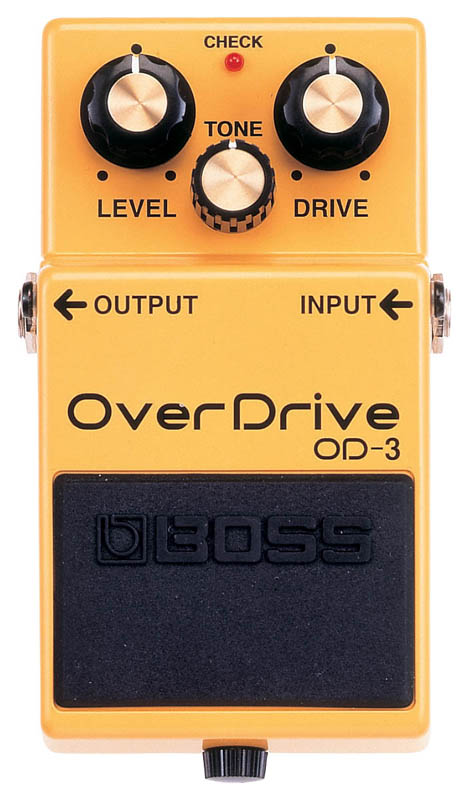
Overdrive (óvərdrɑ̀yv) is the sound of a tube amp being pushed to its volume limit. The sound of an electric guitar through an overdriven tube amp being pushed to distortion is one of the cornerstones of rock and blues music. In its original form, the sound was achieved by cranking the volume full up and […]

The Phaser (?f?z?r) is an effect used to elicit a psychedelic sound in electric guitars. The sound signal of the guitar is altered through the addition of peaks and troughs in the music’s frequency. The phaser splits each audio signal into two distinct paths. The phase of one of the paths is altered so that the frequencies of the two paths will cancel each other out. When the signals are canceled out, the sound leaving the guitar becomes swirly. Phasers were very popular during the 1970s. Although they died out for a period of time, their effects can still can be heard in primarily in guitar solos today.
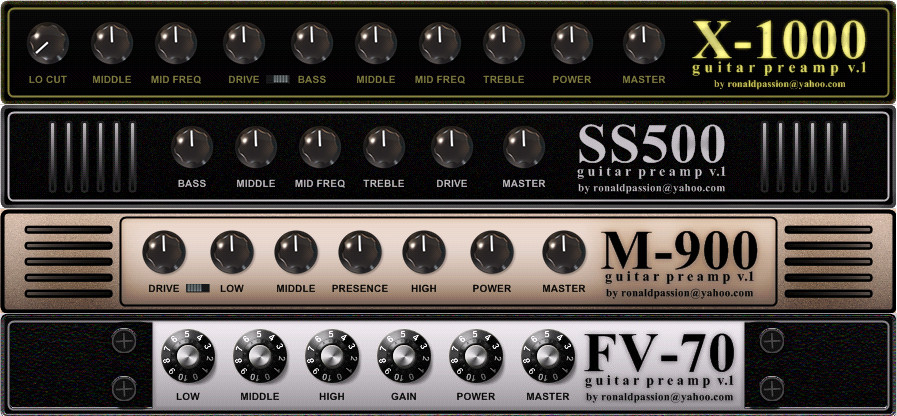
The Pickup (p??k??p) is a device that magnetically amplifies the vibrations created when the strings are plucked or strummed. An electric current flows through the metal receivers of the pickups to accurately relay the vibrating movements to the guitar’s amplifier. While pickups are a mandatory feature for all electric guitars, some acoustic guitars have pickups as well. Acoustic guitars with pickups are usually called acoustic-electric guitars.
There are various styles of pickups, but the main styles are humbuckers, single coil and double coils. Different pickup styles have different sounds. For example, the humbucker style of pickup is often used by rock guitarists because of its full tone. The double coils have a biting sound to them, and they are often used by blues and jazz guitarists. Some guitar players customize their guitar to incorporate both humbucker pickups and double or single coil pickups. This allows for great versatility in guitar playing. The different pickups can be toggled by the switch that is usually located close to the volume knob.
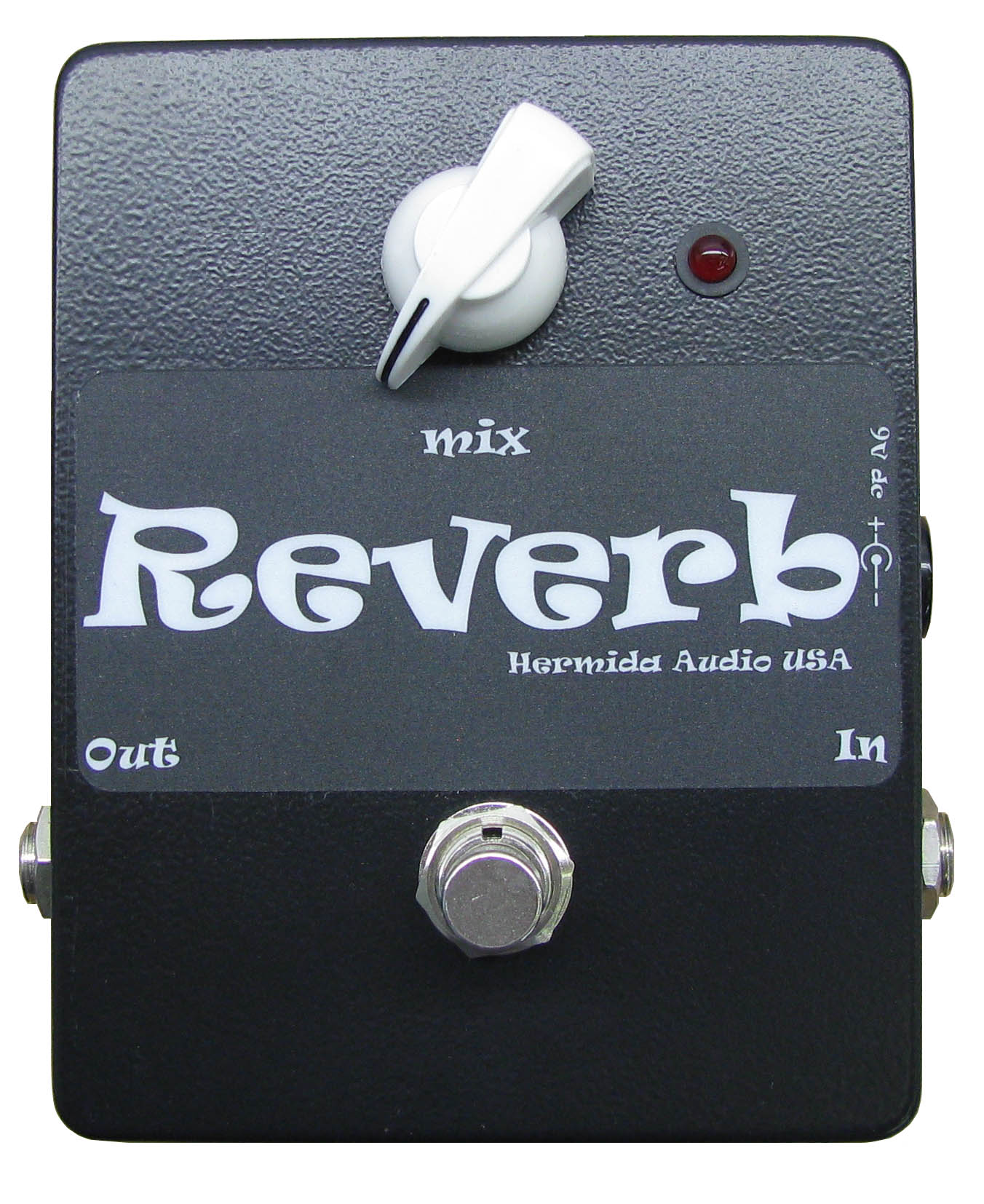
The Reverb (ree – vurb) effect, short for “reverberation”, is a common effect often used to create “bigness” or to facilitate the illusion of a guitar’s tone being engineered in an environment in which it is not. This effect is used to replicate the sound created by when playing the guitar in a variety of environments, such as a chamber hall, an arena or a jazz club.
There are many sound devices which are made to simulate reverb effects of many situations. Reverberation effects are based on processing exact duplicates of the sound wave of a guitar between 50-100 ms after the original sound was made, a phenomenon also known as a delay, flanging or an echo.
A Stack (stak) is a term that refers to an amplifier mounted on top of two 4″ x 12″ speaker cabinets. The term is originally credited to Peter Townshend of The Who, who was one of Marshall Amplifiers’ first celebrity clients. After his roadies threatened a mutiny against moving a gigantic 8×12 cabinet, Marshall divided the speaker array into a pair of more manageable 4×12 cabinets that could be stacked on top of each other. The huge sound, volume, and striking visual image soon became a rock standard.
Jimi Hendrix, Eric Clapton, Jimmy Page and Jeff Beck are just a few of the influential Marshall stack players in rock guitar history.
Watch short & sweet videos (5-10 minutes) that will actually teach you something useful.
Learn from masters level musicians with a minimum of 15 years full-time teaching experience.
Get anytime access to guitar instruction your computer, tablet & mobile device!
Master basic guitar fundamentals, chords, scales & your favorite styles of music or song.
We do everything we can to make our members Happy! That includes our 30 day, no-questions-asked, money-back guarantee.
Be heard. We love questions & lesson requests. New articles & videos publish constantly.


