
Classical Crossover (klǽsɪkəl krɔ́sòvər) music is a term used to describe music that has “crossed over” the record charts from one genre of music to another. Classical crossover music can describe, for example, music that occupies a place on the charts of both classical music and popular music. Pachelbel’s work “Canon in D” is an […]
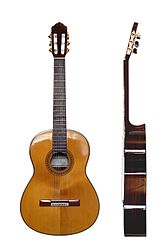
The Classical Guitar (kl?s?k?l g?t??r) is a string instrument. The modern Classical guitar is an esthetically pleasing wooden instrument made up of a machine head, pegs, nuts, a fingerboard, frets, a sound hole, a body with a waist and a flat back, strings and a bridge. Unlike the steel-string acoustic guitar or the electric guitar, the classical guitar is played with nylon strings, which create a more smooth and subtle tone.
The Classical guitar lends itself to many types of music, including folk, Brazilian and classical. The Classical guitar has also been a staple of folk-rock music, and gives a richness and beauty to the songs of Peter, Paul and Mary and Bob Dylan, among other folk-rock artists.
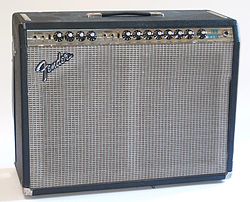
Clean Tone (kl
College Rock (kálɪǰ rák) College Rock is a form of music that became popular in the 80s and was the first term used for what is now known as Alternative Rock. This style of music got its name from the underground college radio stations, where college students were into a completely new sound of rock. […]
Compression (k?mpr??
Contemporary Blues (kəntɛ́mpərɛ̀ri blúz ) is a subgenre of the Blues category of music. After the Blues began to fall in popularity in the 70s, the R&B sound was becoming more popular.Contemporary Blues was born by drawing heavily upon the traditional acoustic guitar sound of traditional Blues and the sounds of the Electric Blues. The […]
Country Blues (kə́ntri blúz), often referred to as Acoustic Blues, is a subgenre of the Blues category that refers to any blues with a guitar-driven sound. It is often combined with gospel, ragtime, and hillbilly music. This music style is founded in the acoustic sound, giving the music a more homegrown feel over traditional Blues. […]
Crunch (kr??n?) is the musical term used to describe a highly distorted guitar played with a palm-mute picking articulation. The distortion creates a heavy, crunchy sound that embodies a lot of tension. Achieving the standard crunch sound is usually accomplished by running an electric guitar through a distortion pedal and into an amplifier with low- and high-end frequency equalization. The guitar is played with a pick, usually on the lower bass strings. The crunch guitar sound is most often associated with rock, metal, and punk rock music.
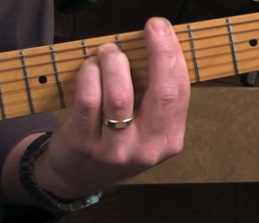
Dampening (d?mp?n??) is a technique that softens or almost entirely eliminates the tone of a note. To dampen a chord, a guitar player strums a chord with his strumming hand and dampen some strings by applying less pressure to them than a normal fretted note. This practice can be done in a rapid way or slower method depending on the desired effect. The effects of dampening on the guitar can be very dramatic. When played successively, dampened notes may hardly resemble the actual note at all although the tone will still ring true to the chord.
Dampening is used across many genres of music such as bluegrass, rock n’ roll, country, and even classical music. Classical music may use the dampening effect with
Watch short & sweet videos (5-10 minutes) that will actually teach you something useful.
Learn from masters level musicians with a minimum of 15 years full-time teaching experience.
Get anytime access to guitar instruction your computer, tablet & mobile device!
Master basic guitar fundamentals, chords, scales & your favorite styles of music or song.
We do everything we can to make our members Happy! That includes our 30 day, no-questions-asked, money-back guarantee.
Be heard. We love questions & lesson requests. New articles & videos publish constantly.


