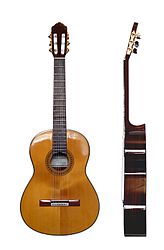
The Classical Guitar (kl?s?k?l g?t??r) is a string instrument. The modern Classical guitar is an esthetically pleasing wooden instrument made up of a machine head, pegs, nuts, a fingerboard, frets, a sound hole, a body with a waist and a flat back, strings and a bridge. Unlike the steel-string acoustic guitar or the electric guitar, the classical guitar is played with nylon strings, which create a more smooth and subtle tone.
The Classical guitar lends itself to many types of music, including folk, Brazilian and classical. The Classical guitar has also been a staple of folk-rock music, and gives a richness and beauty to the songs of Peter, Paul and Mary and Bob Dylan, among other folk-rock artists.

The Chorus Effect (k??r?s ?f??kt) is a sound effect applied in music to add richness, fullness and an ethereal quality to a sound. This effect is accomplished by layering sounds like guitars, pianos or voices of almost the same pitch and timbre over one another to create a single sound. The Chorus Effect is named this because its sound is comparable to a traditional chorus of voices, performing together in similar tone to achieve this
The Bridge (br???) is the piece of the guitar which both holds the strings to the body of the guitar and provides a base upon which vibrations bounce before being transmitted into sound. The bridge is positioned perpendicular in relation to the strings and can affect both a guitar’s tone and pitch. Typically constructed from a single piece of wood, the bridge is normally fixed in place. Although some electric guitars utilize a tremolo bridge, which is metal and can be easily adjusted, most bridges are fixed in place and should only be adjusted by a luthier (guitar expert).

A Barre Chord (b??ri k??rd) is a type of chord that requires a guitar player to use one finger to press more than one string down at a time. These types of chords are extremely versatile as, by sliding up and down the neck of the guitar while keeping one of a few barre chord hand shapes, they can be used to form different chords easily.
Though not complex in theory, barre chords are tough for beginners because they require maintaining constant pressure over the multiple strings at once. As the strings digging into the untrained unhardened finger can be uncomfortable, some players use metallic finger sleeves for people initially learning barre chords.

The Archtop Guitar (archtop g?t??r) is an acoustic or semi-acoustic steel stringed guitar that takes its name from its distinctive curved or arched top. The design is credited to Orville Gibson, whose 1898 patent for a mandolin included design specifications and construction techniques also applicable to guitars. The design incorporates a violin style arched top and back, each carved from a single block of wood that creates a need for internal bracing, f-holes on the stomach, a stoptail or moveable bridge and a tailpiece.
The distinctive rich tone of these guitars made them particularly suited to electrification, and they quickly became staple instrumental accompaniments in the Big Bands and Swing Bands of the 1940s. The archtop fell out of style in Pop music for a time, but has seen a revival since the 1990s, and have remained popular with jazz and blues musicians since their inception in the early 1900s.
Watch short & sweet videos (5-10 minutes) that will actually teach you something useful.
Learn from masters level musicians with a minimum of 15 years full-time teaching experience.
Get anytime access to guitar instruction your computer, tablet & mobile device!
Master basic guitar fundamentals, chords, scales & your favorite styles of music or song.
We do everything we can to make our members Happy! That includes our 30 day, no-questions-asked, money-back guarantee.
Be heard. We love questions & lesson requests. New articles & videos publish constantly.