
A Stack (stak) is a term that refers to an amplifier mounted on top of two 4″ x 12″ speaker cabinets. The term is originally credited to Peter Townshend of The Who, who was one of Marshall Amplifiers’ first celebrity clients. After his roadies threatened a mutiny against moving a gigantic 8×12 cabinet, Marshall divided the speaker array into a pair of more manageable 4×12 cabinets that could be stacked on top of each other. The huge sound, volume, and striking visual image soon became a rock standard.
Jimi Hendrix, Eric Clapton, Jimmy Page and Jeff Beck are just a few of the influential Marshall stack players in rock guitar history.

Steel Strings (st
A Stomp Box (st??mp b??ks), also commonly referred to as a “foot pedal”, is an electronic device used by electric guitar players to modify their instrument’s sound. As stomp boxes are equipped with foot-activated switches, their name refers to the practice of putting the device on the floor and using a foot to turn it on and off.
As with all pedals, guitarists plug their instruments into a stomp box and then plug that device into an amplifiers. Guitarists who wish to use several stomp boxes often mount them on pedalboards, which are designed to accommodate provide power to a number of pedals. Most pedals will also run on batteries (usually 9v). Most pedals have several other controls to tweak their characteristics, such as gain, volume, or tone knobs. Certain pedals such as volume pedals and wahs can be manipulated with a foot as the guitarist plays.

The term String Gauge (str??? g
String Skipping (str??? sk??p??) is a technique where the guitar player disrupts the flow of an improvisation or constructed solo by skipping down or up a string. For example, if a player is playing a solo that starts on the G-string, he can skip the B string and instead play on the E string. Therefore, string skipping is exactly what it sounds like.
String skipping is usually only used during a solo. Moreover, many players skip more than one string for an extreme effect. Many jazz players skip three or more strings when playing sequences that contain fast chord changes. Metal players, however, typically only skip one or two strings at a time.
The term Sustain (s?st
Sweep Picking (sw
Tambour (tambour) is a technique used heavily in Latin and classical guitar, where the guitarist rapidly beats the strings of the chord, generally located immediately inside the bridge, with the flat side of the right hand. The desired effect of this technique is to produce percussive sounds, similar to a snare drum, which permits the strings to vibrate. While using tambour, a range of tones can be created by striking varied distances from the bridge with distinct parts of the right hand or thumb. Performed incorrectly, the tambour technique can instead cause the sound of the strings to be dampened.
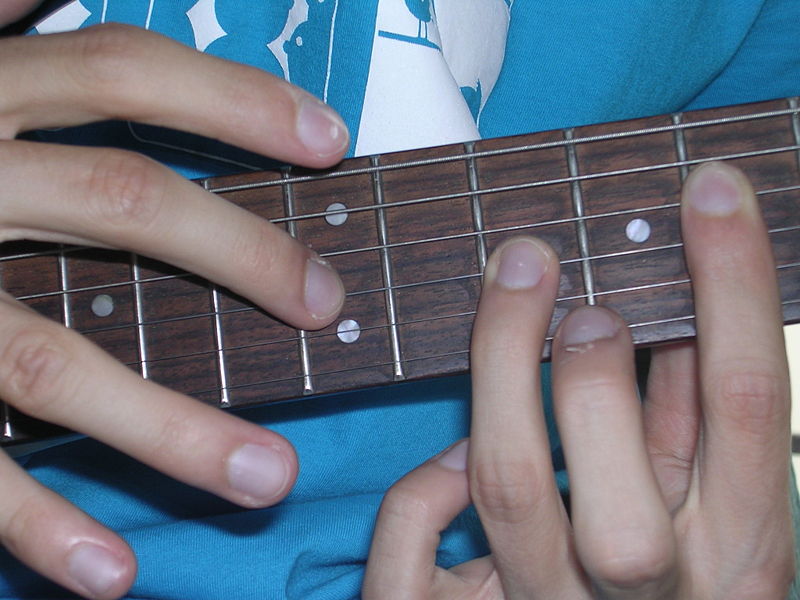
Tapping (t?p??) is a term that describes a specific playing technique, where instead of strumming, players use the pressure from their right hand to push down on the strings that they want to sound. Tapping is accomplished easiest by performing a hammer-on with the fretting hand, and one additional hammer-on with the strumming hand. Therefore, tapping is usually just two hammer-ons performed simultaneously. Most players use their strumming hand’s index finger, but some players find it comfortable to use their middle finger.
Watch short & sweet videos (5-10 minutes) that will actually teach you something useful.
Learn from masters level musicians with a minimum of 15 years full-time teaching experience.
Get anytime access to guitar instruction your computer, tablet & mobile device!
Master basic guitar fundamentals, chords, scales & your favorite styles of music or song.
We do everything we can to make our members Happy! That includes our 30 day, no-questions-asked, money-back guarantee.
Be heard. We love questions & lesson requests. New articles & videos publish constantly.


