
Grunge (grə́nǰ) is a style of rock music that relies heavily on the punk sound. This style was born and raised in Seattle and is often called the Seattle sound. Made popular in the nineties, this style of music incorporates heavy rifts and guitar distortions with an apathetic and frustrated angst in the lyrics. Grunge […]

The Guitar (g?t??r) is a stringed instrument made of various woods, such as maple, rosewood and oak or in some cases a combination of multiple types of wood. A very popular instrument, the guitar’s roots stem back to medieval times with the Baroque guitar. Many people assume that the lute was the beginning of the modern guitar.
As the is a stringed instrument, the guitar’s sound is made when its player strums of plucks its strings, causing vibrations to resonate in harmony. Guitars typically have six strings, but many guitars are made with 7 or 12 strings. Guitars with 12 strings contain the same notes as a guitar with 6 strings; however, all the strings are paired in two’s for an octave effect.
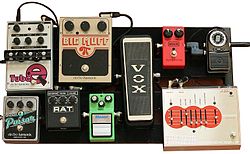
Guitar Effects (g?t??r ?f??kts) are devices used to enable a guitar player to alter the sound coming from the instrument. The traditional method of use is when a guitar is plugged into a guitar effect/s which is then plugged into an amplification source. Guitar effects receive a signal from the guitar and then alter the signal before it is sent onto an amplifier.
There are a variety of guitar effects that are available. Effect levels can be increased or decreased and are most often controlled with foot pedals. Effects are used in combination to form recognizable tones and these combos enable the creation of signature sounds. Some of the more common effects include distortion and fuzz boxes which exaggerate the vibratory levels of the strings resulting in a distorted sounds. Other effects include Flanger which adds a sweeping and revolving loop to the sound and Chorus which brightens the tone and multiplies the sound itself.
The Hammer-On (h?m?r- ??n) technique is when notes are played on the neck of the guitar by pressing the fingers on the strings behind a fret, then removing them quickly, as if the strings were being “hammered”. It is the opposite of the “pull off”, which is when the guitar player rapidly presses his/her fingers on the strings and then lifts them off resulting in their ability to speedily play notes and expand their sound. The sound of the hammer-on notes will not be as vibrant as those that are plucked with the strumming hand. The hammer-on is typically used in metal music but it can also be found in rock or bluegrass.
Hard Rock (hárd rák) is a subgenre of rock and roll that has its roots in many different places. Its earliest form came about in the mid-60s and continued to grow in popularity during the 70s. Peaking in the late 80s, the style of music finally found its audience. With a drastically heavy use of […]
Hardcore Punk (hárdkɔ́r pə́ŋk) is sometimes referred to as just punk, but has a much harder and faster sound than the original punk. Unlike other forms of music that focus more on the melody, Hardcore Punk emphasizes the rhythm in the music. Often featuring screams, chants, and even spoken poetry, Hardcore Punk is a unique […]
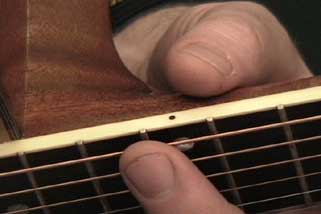
The Harmonic (harm??n?k) is a unique sound produced on the guitar by touching a string very lightly over certain frets with your left hand while your right hand plucks the strings. To allow harmonics to ring you must quickly removing your left hand as you pluck. Producing harmonics on the guitar string requires practice, as the finger pressure and timing must both be accurate.
The term harmonic is sometimes used equivalently with the term overtone, as both sounds are created when the guitar or other instrument produces multiple frequencies known as partials. The primary difference is that harmonics and overtones are counted slightly differently when you are determining where on the string to touch to create the sound you are looking for.
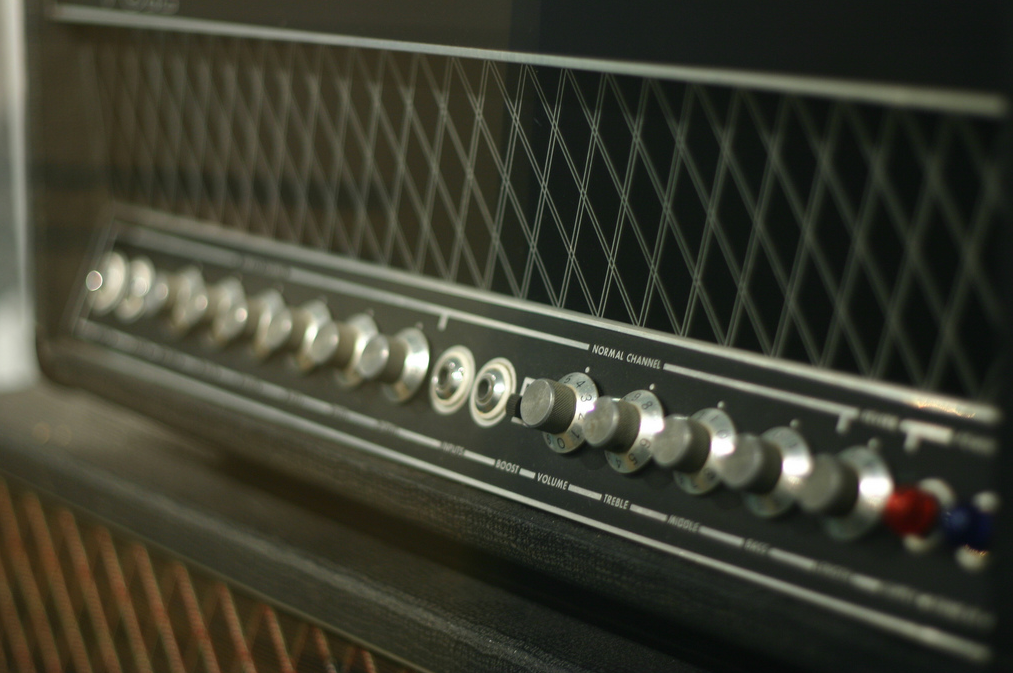
The Head (h??d) of an Amplifier refers to a stand-alone portion of a guitar amplifier setup, which contains the pre-amp and power amplifier sections, but not speakers. An electric guitar is plugged into the wood or metal-enclosed head, which in turn is plugged into the speaker cabinet. The head is responsible for the preamp stage of the guitar signal, which usually contains controls for gain and tone, which then feeds into the power amp stage, which is responsible for volume output to the speakers.
The head is usually placed above one or two stacked speaker cabinets. This configuration is referred to as a “half-stack” or “stack”, as opposed to a “combo” amplifier which contains the pre- and post-amp, including a speaker(s), within a single cabinet.
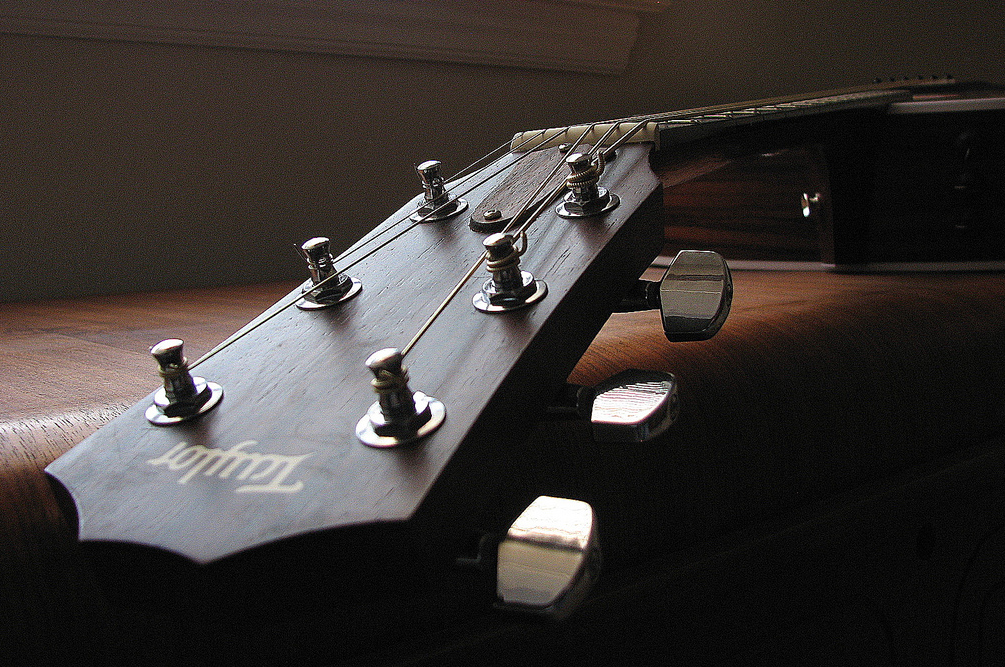
The headstock (headstock) or “head” of the guitar is the part of the guitar located at the very end of the instrument
Watch short & sweet videos (5-10 minutes) that will actually teach you something useful.
Learn from masters level musicians with a minimum of 15 years full-time teaching experience.
Get anytime access to guitar instruction your computer, tablet & mobile device!
Master basic guitar fundamentals, chords, scales & your favorite styles of music or song.
We do everything we can to make our members Happy! That includes our 30 day, no-questions-asked, money-back guarantee.
Be heard. We love questions & lesson requests. New articles & videos publish constantly.


