Reading an Electric Tuner
Electric tuners use either the string number and/or letter names:
 E(6)
E(6)
A(5)
D(4)
G(3)
B(2)
e(1)
In Tune:
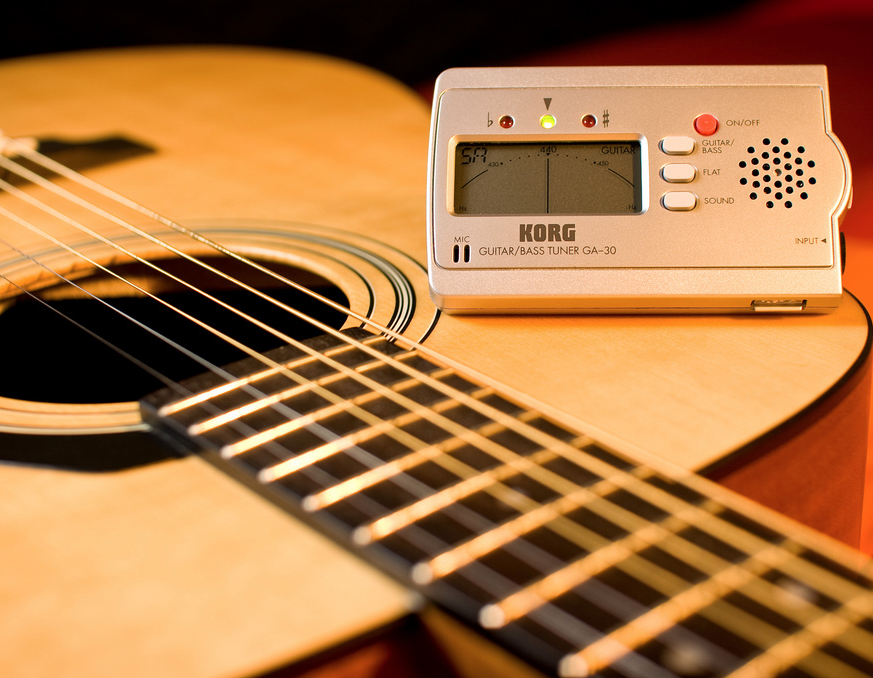
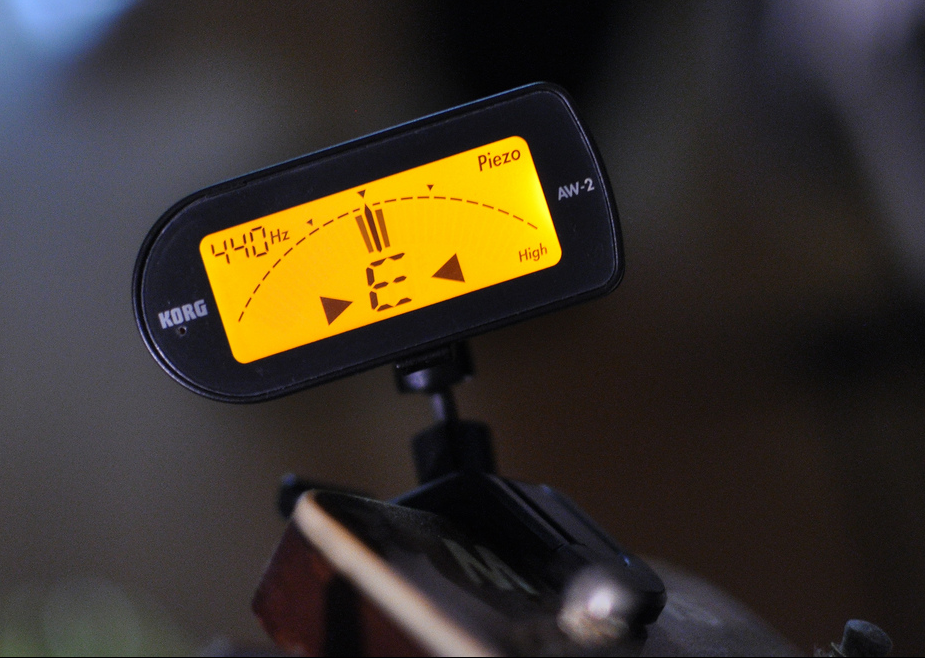
 Make sure that the name or number on the tuner corresponds correctly to the string you are plucking. If the tuner points at the center mark in its display dial when you pluck a string, that string is in tune.
Sharp:
 When a pitch is too high. When tuning, if the needle goes past the center mark of the dial that string has too much tension and is sharp.
Flat:
 When a pitch is too low. When tuning, if the needle does not make it to the center of the display, the string you are tuning needs more tension and is flat.
Tuning Tips
- When you turn your tuning pegs on your guitar, a little goes a long way!
- The musical alphabet goes in order, and repeats: A-B-C-D-E-F-G-A-B…
- If you are tuning your D string, and the tuner says C, or C#, that means you are flat and need to tighten the string until the tuner reads D.
- If you are tuning the C string, and your tuner shows a D, the string is too sharp. Loosen the string.
- Most tuners work best when you pluck each string close to the 12th fret.
- Keep plucking your string to give the tuner the best chance at reading your pitch correctly.
(Visited 1,435 time, 1 visit today)
Video Transcript
The first thing that we want to do is to make sure you know how to read one of these electronic tuners. Whether you have the kind that has a microphone or the clip-on type, they both have very similar display, and most tuners work under the same idea. You have a spectrum, almost like a speedometer, and the needle that moves around. When the needle moves to the right point in the spectrum, it tells you the string is in tune.
Before we get started, let’s just quickly review the names, and the numbers of the strings. Number 6 is the thick one on top, and then 5, 4, 3, 2, 1. Number 1 is the one on bottom. Some Tuners reference the strings by the numbers, some tuners reference them by the name. So, we have to review the names. E, A, D, G, B, E - that was going from 6 to 1. Remember that little thing that we said earlier: Elephants And Dogs Got Big Ears.
So, let’s take a look at the E string. I am going to pluck this string [Plucks the 1st / e-string], and what you can see [Shows tuner display], is I’ve got this needle that comes to the center point on my spectrum. That little notch right in the center is where you want the needle to go. If it lines up with the notch, your string is in tune. I am plucking the 1st string, [Plucks the string], that’s the E string [Plucks the string], and the tuner confirms it, it says “E”. So that’s in tune.
I’ve put the next string out of tune, I made it too sharp. Sharp means that there is too much tension on the string. The note is too high. We have to loosen the string a little bit and lower the pitch. Let’s see what happens [Plucks the string]. The needle goes past the notch. So, I gently turn the Tuning Peg here [Plucks the string while loosening it], and take some tension of the string.
Let’s look at the next string, this is the G string, I’ve made it too flat. Flat means there is not enough tension on the string, and I am going to have to tighten the string up a little bit. So, the needle, as you will see [Plucks the string], doesn’t even make it up to that notch. I got to tighten that string up... [Plucks the string few times while tightening it]. There we go, I am in tune.
Also notice that, as I make these adjustments, I keep plucking the string, that will help the Tuner know what note it’s on. Sometimes your string will be so out of tune that, for example, this 1st string, let’s tune it to an E. So, this is supposed to be an E. Let’s say it’s really flat. [Plucks the string few times while loosening it]. So flat, that the note that comes up on the display is not an E. Now you have to think about the regular alphabet, and the musical alphabet. A moment ago I had that note at E. Then I loosened it, and now it’s D. The way the musical alphabet works is, A is like the lowest pitch, B is a little higher, C is a little higher, D is a little higher. So if it is supposed to be E, but it reads D, well D is lower than E, so you have to tighten the string up until the E comes on the display. [Plucks the string] Here is my D note, that is supposed to be E. [Plucks the string while tightening it]. And I am going to tighten it up. There we go.
One last thing to point out is, sometimes the Tuner has trouble reading what string it is. This is especially the case with the thicker strings. Something you can do, that will help to tune her out a little bit, is to pluck the string in the middle. This is somewhere around the 12th Fret. [Plucks the string at 12th fret]. I am going to use my thumb, use the fleshy part, and just pluck the string gently. That will give the tuner the best shot at knowing what note it is. Sometimes that note still doesn’t come up on the tuner, you just have to be patient, keep plucking it, maybe move your thumb around a little bit, and eventually your note will come up. And that is how to use the electronic tuner.
FAQ
What does the “calibration” button on a tuner do?
Tuners work by assuming your “A string” (5th string) resonates at 440 Hertz. That’s the most common sound for the A (5th String) in the U.S. The calibration can adjust so that the whole guitar is in tune, but slightly flat or sharp from 440. In certain parts of the world - South America and Europe for example - people use a different reference note to tune to, and the Calibration button let’s your tuner tune to these alternate tunings.
What can I do to train my ears to do what the tuner does?
The best way to improve your ear is to sing. To train your ears don't just sing the words from songs but also the sounds from your guitar. Play a note, then see if you can sing it. It may sound simple, but it works to help improve the connection between your brain, ear and instrument.
My tuner seems to turn itself off after a while. Is this normal?
Yes. Many tuners have a function whereby they turn off if they don’t detect any tuning going on, in order to preserve battery life.