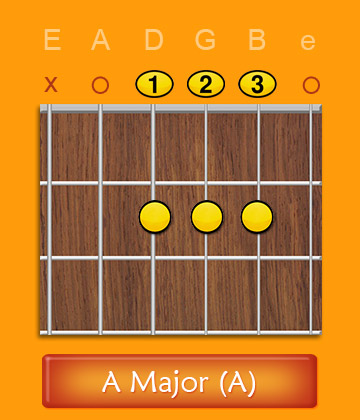
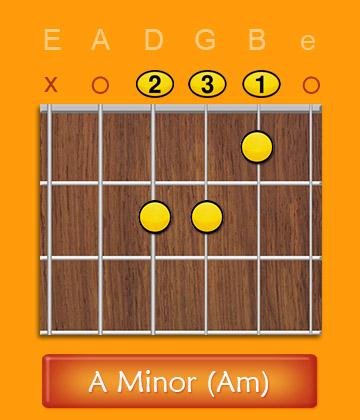
This video is for the A minor chord. When we speak about minor chords we always have to say the word minor in order for people to understand us. This is an open chord, let’s hear how it sounds. So it’s a little bit kind of sad and wistful sounding. Here’s the A major chord, or just the A chord as sometimes people call it. Now back to the minor.
Let’s break down our fingering. For most people the easiest way to start is with the pointer finger on this one. We’re going to go the second string first fret. And now we’re going to add the third finger to the third string second fret. Not the second finger, it needs to be the third finger. And then you’re going to reach over with the second finger onto the fourth string second fret. Those last two fingers will end up touching each other, kind of squeezing together, and that will help the chord ring out nicely. On the diagram you can see that there are open strings for number five, the fifth string, and the first string, and there’s an X over the sixth string. So we’re not going to strum the sixth string. And we give it a strum. That’s how it should sound.
It’s going to be common in the beginning that the index finger might be rolling back and muting the first string. So again, just kind of shift your hand forward a little bit. Get the fingers nice and bent, and don’t press too hard.
And that’s the A minor as an open chord. We can do it as a barre chord in various ways. We can power chord it. And if you want to learn about those ones you can check out the chord book.