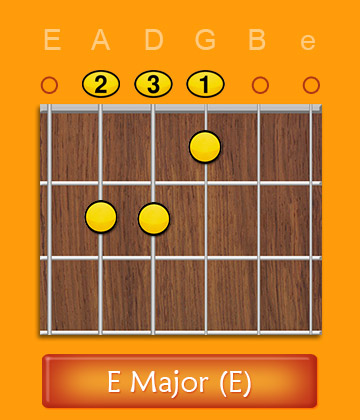
This video is for the E minor chord. It’s a minor chord, you need that word. And it’s an open chord. Let’s hear how this sounds. Really big sounding chord, we’re going to be strumming all six strings. Let’s hear the E major chord and the E minor.
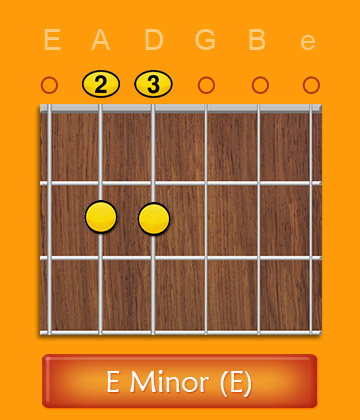
So this one you have to be a little careful with the fingering or the difference between the major and the minor might not be audible. Let’s look at the fingering and that will explain the reason. So for this one there’s only two strings that you press down, it’s probably one of the easiest chords on the guitar. You use typically the second finger and the third finger. We don’t use the index finger on this. And what you’re going to do is place the second finger on the fifth string second fret. And now the third finger is going to go on the fourth string second fret. They’re going to be nice and snug here. And that’s it.
You have to be careful not to let this third finger roll over and mute that third string because that third string is an open string as you’ll see in the diagram, and that’s the note that really makes the chord sound minor. So if that note gets muted it doesn’t really sound major or minor. If you think about the index finger that’s normally part of the major chord, it’s that index finger that comes up, releases, and allows that note to change tones. So if we can’t hear that note it’s not really an E minor chord.
In the diagram you will also see that there are open strings on number six, three, two and one. So, that’s the open E minor chord. You’ll use it a million times. And as with all chords there’s barre chord versions, and power chord versions, and those are contained on the chord book.