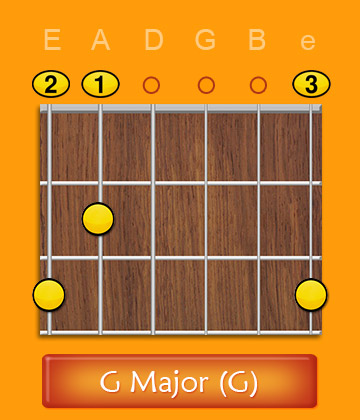
Fingering for the Open G Major Chord

- Place your middle finger on the sixth string third fret
- Place your pointer finger on the fifth string second fret
- Place your third finger on the first string third fret.
- The fourth, third and second strings are open.
First Alternative Fingering

- You can also use the pinky instead of the third finger on the first string third fret.
- Place the ring finger on the sixth string third fret
- Place the second finger on the fifth string second fret.
Second Alternative Fingering

- Place the pinky on the first string third fret.
- Place the third finger on the second string third fret.
- Place the second finger on the sixth string third fret.
- Place the pointer finger on the fifth string second fret.
(Visited 19 time, 1 visit today)
Video Transcript
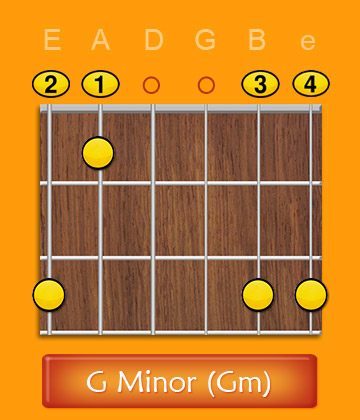
This video is for the G chord or the G major chord. And this is definitely an open chord. It’s one that you will play many times. The first G chord that we’re going to learn is considered the most common and the most basic. Let’s listen to how it sounds. And this chord doesn’t really have an easy minor chord version as an open chord. Most people barre it. So that would be a G minor, it’s kind of sad. Here’s our happy G major.
So let’s look at the fingering here. There’s a couple different ways. Let’s start with the easiest one. This is not necessarily the best one, but it’s certainly the easiest one. You’re going to start with your two strong fingers, your index finger and your second finger. Let’s start with the second finger; we’ll put that on the sixth string third fret. And your pointer finger goes on the fifth string second fret. And then the third finger is going to go all the way across to the first string and that’s on the third fret. You can see that the fourth, third and second strings are all open. And let’s hear how that sounds.
For this particular finger some people, instead of the third finger on the bottom they prefer the pinky, that’s fine. If the pinky starts feeling comfortable there you can start experimenting with the more difficult fingering, but this is considered more technically correct because it allows you to transfer to other chords more easily, like a C chord.
And here’s that fingering, you can start with the pinky on the bottom string, first string third fret. And then the ring finger reaches all the way across to the sixth string third fret. The second finger now comes down on the fifth string second fret. So it’s all the same notes, same locations but different fingers. And your index finger is not included. You’ll definitely notice if you’re new to guitar that this is a lot more difficult than the other fingering.
And finally there’s one other fingering that’s kind of medium difficulty, and this is also common. All of these are interchangeable with one another. And here’s that fingering. It starts with the pinky just like the last one on the first string third fret. And then you take the third finger and you put it right next to it on the second string third fret. The other two fingers are like before; the second finger reaches over to the sixth string third fret. And the pointer finger now goes on the fifth string second fret.
Which has a slightly different sound. Let’s compare the sounds [MUSIC] versus [MUSIC]. Very small difference, so totally interchangeable. It’s good to know them all. And that’s the open chord. As with all chords we have barre chords, power chords and you can find out about those in the chord book.