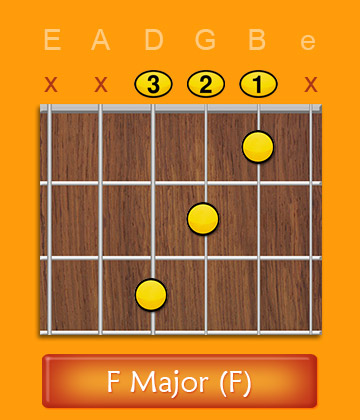
Fingering for the Open F Major Chord:

- Place your pointer finger on the second string first fret.
- Place the middle finger on the third string second fret
- Place the ring finger on the fourth string second fret.
- Don’t play the sixth string, the fifth string and the first string.
You can mute the bottom string with the backside of your pointer finger.
Alternative Fingering:

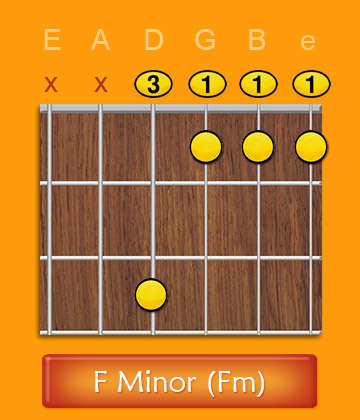
- You can use your pointer finger to press down and do a mini-barre so it presses on the first & second string.
(Visited 17 time, 1 visit today)
Video Transcript
In this video we’re talking about the F major chord. The F major chord is again considered part of the open major chord family but technically it has no open strings. Here’s the sound of the chord. Here’s the F minor, F major. So it’s got that happy major chord vibe.
Let’s look at the fingering. There’s various ways to play the F. This is generally considered the easiest one, and it’s the one that most people learn first. It’s a diagonal line that you form with your fingers, and you can start with the pointer finger on the second string first fret. And then you go third string second fret with the second finger. And then the fourth string on the third fret with the third finger. There’s X’s on the sixth string and the fifth string, so we’re not going to strum those. And the bottom string for now we’ll put an X on that. And the way you would create that X is with the backside of your pointer finger. You’re just going to mute that out. So that’s considered a basic F chord.
If that index finger can press down a little bit and you can do a little mini barre, that’s also considered an F open chord. So now on the diagram you can see that there’s a one on the second string and a one on the first string. And these are two chords that are interchangeable.
Now the F chord is a difficult chord. A lot of people hate the F chord. And a lot of people once they get familiar with it, they choose to add more strings. You can add a fifth string to it, and you can even do a full barre, but technically that’s a barre chord, it’s no longer really an open chord. There are other barre chords and power chords. And you can find out about those in the chord book.