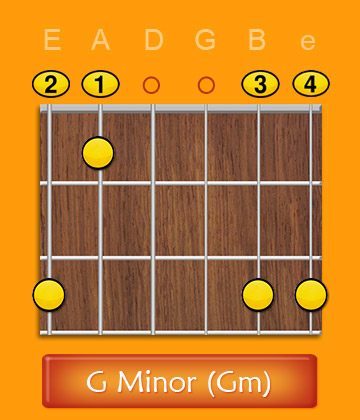
This video is for the G minor chord. This is one of those chords that’s part of the open chord family but doesn’t always have open strings. There’s kind of two different ways that you can do it and we’ll go over those. It’s a minor chord; remember to say that word minor. Let’s listen to how it sounds. Here’s a simple one that doesn’t have any open strings. And here’s a bigger sounding chord that’s a little bit stretchy but does have open strings.
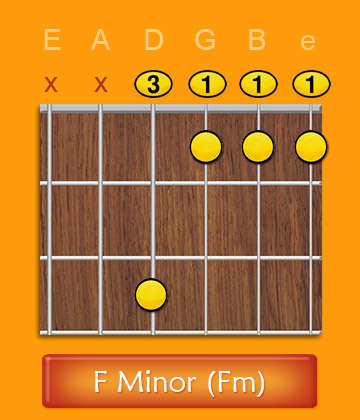
So let’s look at the fingerings for these. The first one we’ll do is a little bit more like a barre chord. So it’s a little bit difficult here. We’re going to start with the third finger on the fourth string fifth fret. And from there you take your index finger and you do a little half barre where you’re just grabbing strings three, two and one. If it’s more comfortable to grab a couple extra strings that’s fine, you can do that too. And you’ll see on the diagram though we have X’s on strings six and five, so you’re just strumming the bottom four strings. Let’s hear that.
And where you press with the barre doesn’t change the sound. Want to do that or that, it’s fine. For some people they prefer to use the pinky there. It’s preferable to use the third but it’s okay to use the pinky and for some people they like to double up on that barre so that you have two fingers pressing down. So that’s our G minor.
Let’s look at a version that a little bit more like an open chord because it has open strings. So this one you want to take fingers three and four. And I’m going to take the pinky and put that on the first string third fret. And right next to it I’m going to put down my third finger on the third fret of the second string. And those are held tightly together. And now what makes this chord a little challenging is you have to reach over with your pointer finger to the fifth string first fret and ideally not mute any of the open strings. The open strings, as you see on the diagram, are number four and string number three. In this version the sixth string is X’d out. So there’s that chord. It sounds very nice.
And if that becomes comfortable, and this one is a little bit stretchy, but you can actually add a note on the sixth string, third fret of the sixth string. And you can see there’s kind of a big gap here, it’s not an easy chord. But for a full open G minor chord that’s as best as we have on the guitar because of the tuning of the strings.
So couple different versions of G minor there. You have a full barre chord version as well. And there’s even one up here. And we’ve got some power chords, and you can learn those ones in the chord book.