Now that you’ve got your guitar tuned up, we want to take a minute to talk about positioning, and sitting, and posture, and all that good stuff.
The rules for posture are pretty much the same, as they are in day to day life. You want to sit in a good chair with your feet squarely on the ground. You want to sit up, you don’t want to be slouching or leaning over or anything like that. You want to be comfortable. Loose, relaxed. The chair that you sit in - it is a good idea to have it be a good, comfortable chair. It is not such a good idea to sit on a couch, your bed or something like that. Part of the reason is that, you want to have right angles in your legs. If your legs are too diagonal, the instrument might slip off towards the floor. A lot of players, like myself, like to actually elevate one of the legs on something like the case of your instrument, if it’s a hard case, or a foot stool, or big buck. This slight angle helps the guitar get secured against my body.
For
Electric Guitars and
Acoustic Guitars, for the most part, you want to put it on your right leg. There is this curve in the body [Points to the curve in the body of an electric guitar] that fits perfectly for your thigh. So, I’ve got the instrument on my body. What I am going to do is push it out slightly, and then tilt the top part into my chest, so that I’ve got an angle on the instrument, and I can see the strings. You don’t want to go too extreme [Turns the guitar], you don’t want to try to flatten it out like that. If it’s completely flat, if you’re just starting out, it’s going to be hard to see your fingers. So, it is good idea to get a little bit of an angle.
The
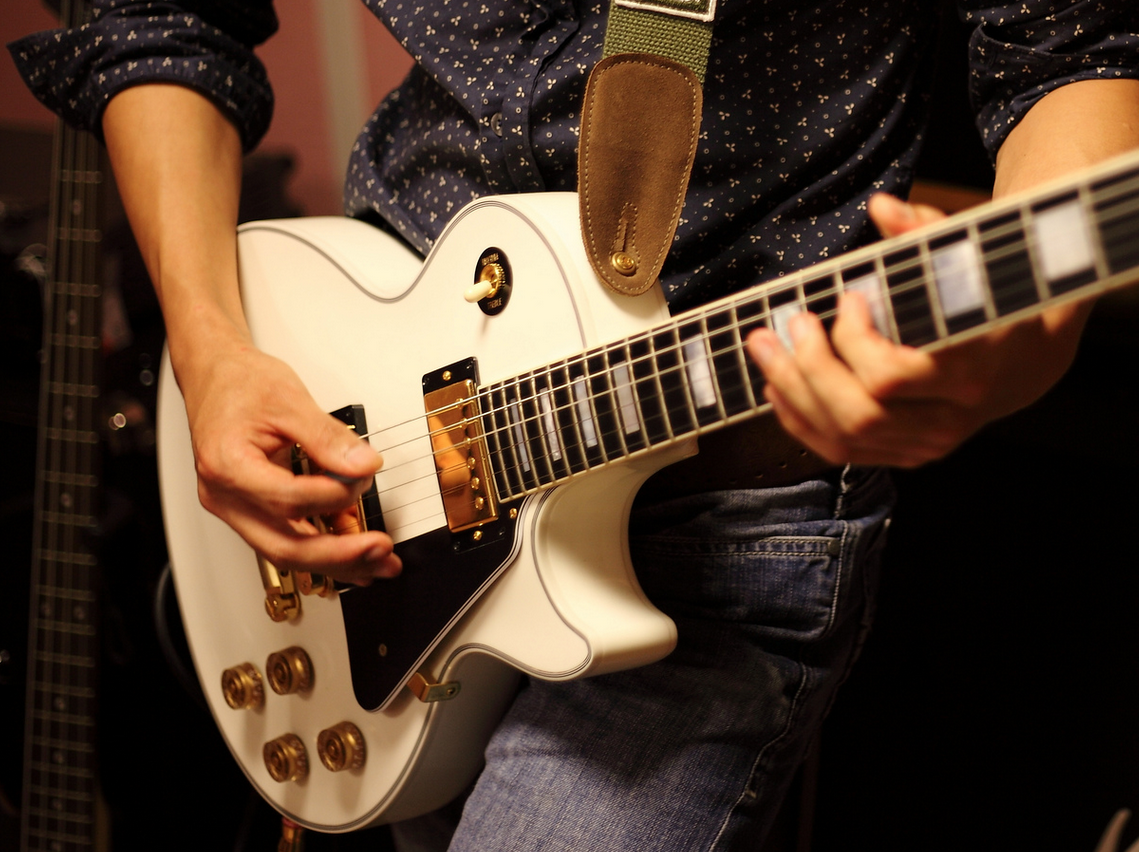
Neck of the instrument should never dip bellow horizontal. [Pushes the neck towards the floor]. You want to keep it flat or, ideally [Lifts the guitar neck slightly up], a slight angle up. Generally, the idea is, it is better to bring guitar towards you, than to go towards it [Leans towards the guitar]. Because that is going to encourage you to slouch, or have other habits that are going to make it difficult to play. I’ve got the instrument on my right thigh, angles of the neck is up here, ready to get going. But, you’ll notice, I have a strap on. This particular strap is the cheap 5$ or 10$ strap, and it does the job. There’s many types. As I’m sure you can imagine, all different materials, shapes, sizes. I’ve got this thick one, that has a foam padding, and it’s wider. It’s a little bit more comfortable. You can get types that have colors, and cool buckles, and all sorts of things. Type of stripe is all about what you’re in to. That’s a cool little thing that you choose for yourself. The important part of the strap is that you want the strap to keep the
Guitar in the same relationship to your body when you’re sitting, as when you are standing. Right now, I’ve got a little bit of tension on my strap, it’s going to keep my guitar in place. And as you can see, the instrument is sitting on my thigh, it’s just bellow my chest. When I stand up to play, I want to have the guitar be in the same place. I am going to stand up, and you’re going to see that the guitar stays in the same relationship to my body [Stands up]. And now, when I sit down [Sits down], nothing’s changed. That is the idea behind the strap.
If you are playing an
Acoustic Guitar, you can also play with the instrument on your right leg. And you can elevate the foot and tilt it. And that is all well and good. However, if you are playing
Nylon String, especially
Classical Guitar, it is suggested that you actually elevate the other leg. You’ll need a foot stool or a big buck or case or something like that. And you end up putting the guitar on your other leg. This will actually work for electric guitars, and even some acoustics But, generally speaking, most people play those instruments on their other leg. The point of this is for couple of reasons. Number one, my right hand can very easily lay on the strings, because in classical guitar, you play with your fingernails. And
Fingerstyle, for that matter. So, it is good idea to have it right here.
And now the
Neck of the instrument is at the very high angle. It’s easier on my left hand, and my wrist, I can see it, placement of the fingers is a little bit easier. One of the last things that it does is, I’ve got a point of contact here, between my body and my left leg, and other point with my right leg, and now I tilt the guitar so that the edge of the body leans into my chest. As a result, the back of the instrument is not touching my body. And for an acoustic
Guitar, it’s going to help the sound project. Many people do play with the guitar on their right leg, some people even cross their legs, in whatever way, but as long as you are sitting with your back pretty much straight, and your shoulders are nice and relax, it’s going to help your hands play in the optimal position.
In the beginning, all of these things might feel like a lot to think about, or worry about. But they are little things that you work on over time. Sitting up a little bit straighter, being a little bit more relaxed. So don’t feel discouraged, if at first you’re like: I have to look at my hand, I have to turn my head... Don’t worry about that. In time, all of this will become very natural.




 Sit in a comfortable chair with your chest up and your feet on the ground. Keep your knees at a right angle to the floor (90 degrees). Some prefer to elevate one leg to help raise the guitar.
 Both electric and acoustic guitars should rest against your right leg. Push the bottom of the guitar away from your body a few inches and angle the top of the guitar towards you. This will help you see the strings while you play.
 Angle the guitar neck slightly up towards your eyes. This will help you see the fretboard while you play. In general, it is better to bring the guitar to you than for you to lean over to see the guitar.
 A piece of cloth, nylon, leather or plastic that attaches to the guitar goes over your right shoulder to hold the guitar in place while you play. The guitar strap should keep your guitar pressed into the same place on your body whether you are sitting or standing.
 Nylon string guitars should be placed on the left leg. This allows you to rest your wrist on the guitar so you can easily pluck strings with your right hand. Keep the neck of the guitar at a higher angle than you would for an electric or acoustic guitar so that you can see the strings easier. Rest the top back edge of the body of the guitar against your chest. By not pressing the whole back of the guitar against your body, you avoid deadening the guitar’s vibration and allow the sound to project.