Now that we know how to place our right arm around the
Body of the instrument, we are ready to start talking about picks. Holding picks, playing with picks, so on and so forth.
What I’ve got in my hand here [Shows five picks], are couple different types. These three here at the bottom [Shows the three picks on the bottom of his hand] are pretty standard picks, pretty standard sizes. This one is nylon [Shows one grey pick], is made of nylon, it’s really thin, and I can bend it like that. This blue one is pretty much rock hard, this is the hard kind of plastic. And these two are called teardrop picks. We actually recommend that you try all different types, different sizes, different materials. It is really about finding the size, and the sound that the pick makes. It is about finding what works for you. And when you go to the store, we recommend that you pick up a bunch of them. Because they are really small, they get lost all the time, so you don’t want to end up out of picks.
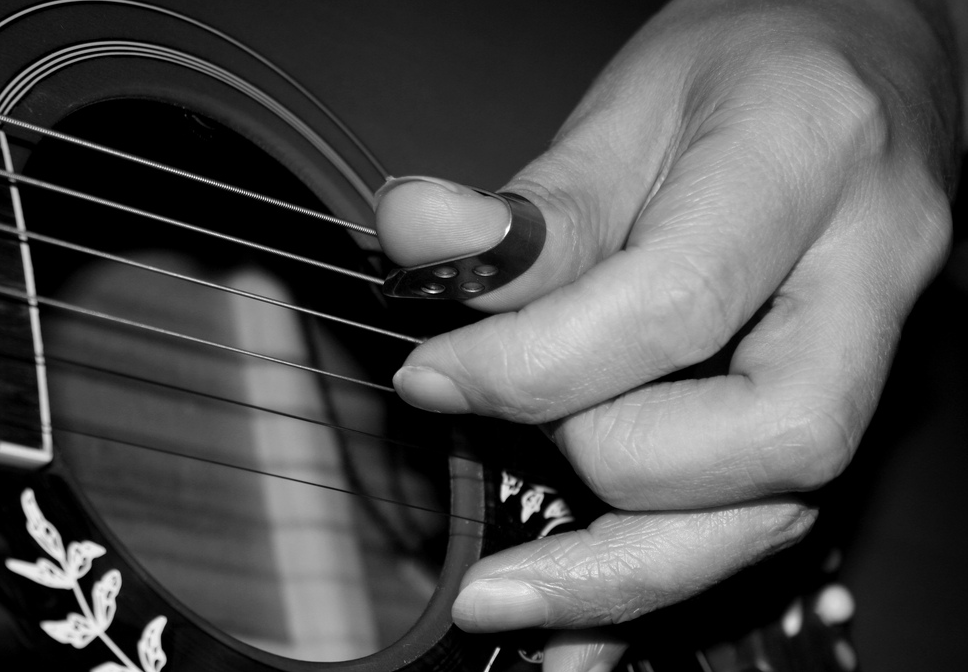
We are going to start talking about holding the picks. I am going to use standard medium thickness pick here. The general idea, is that you want to take your hand and make a fist, and then relax your fingers. Kind of like you are grabbing a stick. There should be some space underneath your fingers. The pick is going to be held between your index finger, and your thumb. So what I do, is I take a pick and I place it on the index finger, towards the end, by the fingernail. Place it like so [Points to the pick on the index finger], and now, when I place my thumb down on it, it’s going to come into the perfect place here. I like to have flesh on my thumb push, you know, going beyond the edge. You don’t want to be just up to the edge of the pick. You want to be able to go beyond it here, it will give you better control. You should be able to flex your thumb, little bit like so [Flexes his thumb], and it should feel relatively comfortable. You don’t want to hold it really tight, you want to hold it pretty loosely.
Let’s apply the pick here [Takes
Acoustic Guitar]. Put it in practice. Before we talk about actually plucking the strings, we got to talk about the motions that the arm can make. Basically, if I swing at the elbow here, I’ve got this really big motion. With the forearm. But if I only use the forearm, for example [Strums few times]. It’s a lot of motion to make some sound.
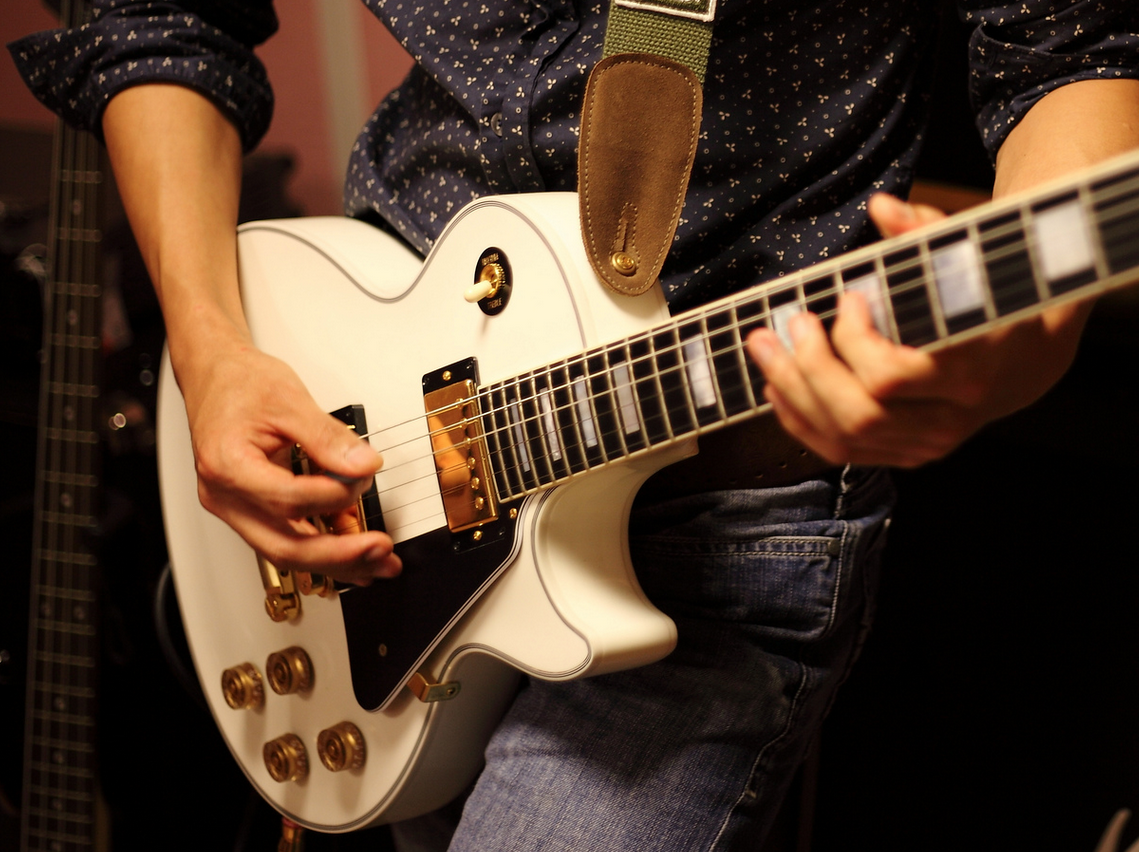
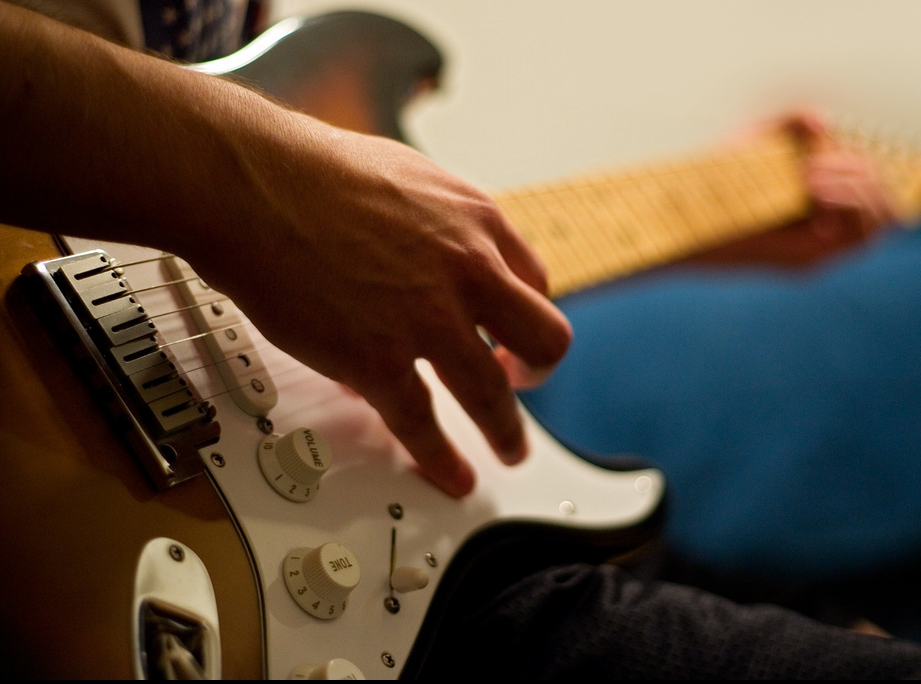
If I use the wrist I can be a lot more efficient. Let’s look at the ways the wrist can move. One way is kind of like turning a door knob, screwing in the light ball. Another way is sort of like knocking. And the third way is like when you write with the pen or pencil. Sort of like this [Moves his hand as if he was writing with the pen]. The range of motion that you get with the door knob movement, is pretty big. In fact, if I keep my forearm completely straight [Strums few times], I can get all of the strings without even moving. If I just do the pencil thing [Strums few times], that’s not going to get all my strings. And obviously the knocking thing [Knocks on the strings] has a limited application. In order to strum the strings, we’ll start by talking about strumming. I am going to use quite a bit of the door knob motion, and little bit of the forearm. [Strums few times]. There’s a little bit of the knocking, just a little bit to help the pick enter and exit the string. It is really the motion and the direction of the pick that is one of the secrets. What I am doing here, is I am making an arc. I am exaggerating. But that is the kind of motion you want.
Some people think that you’re going to pluck a string and then just stop before you hit the next one. The trick is to keep a fluid motion into arc, out of the way of the strings that you don’t want to hit. What you can start doing [Strums one], is working on this arcing motion [Strums few times]. You want to hold the pick nice and lightly [Strums twice]. One thing that you might discover right at the beginning, is that pick might feel like it’s getting caught, kind of like clackedy-clack. If you flex your thumb, you can actually turn the pick on an angle, and that is going to round up the sound. You could push your thumb down a little bit, and that is going to angle it the other way. Same effect [Strums few times]. And that is actually recommended.
So, holding the pick is a little bit complicated, but it’s definitely something you get a hang of, once you start practicing it. It does take a little bit of time, so definitely be patient, and just take little bit at the time. This little exercise here goes a long way, and once you get comfortable with that, you can try picking individual strings. The way to do that, is to miniaturize the motion. Instead of a big arc, you’re just making little arcs. [Plucks individual strings with the pick]. That’s going to start getting your right hand comfortable with plucking the strings, and using the pick.




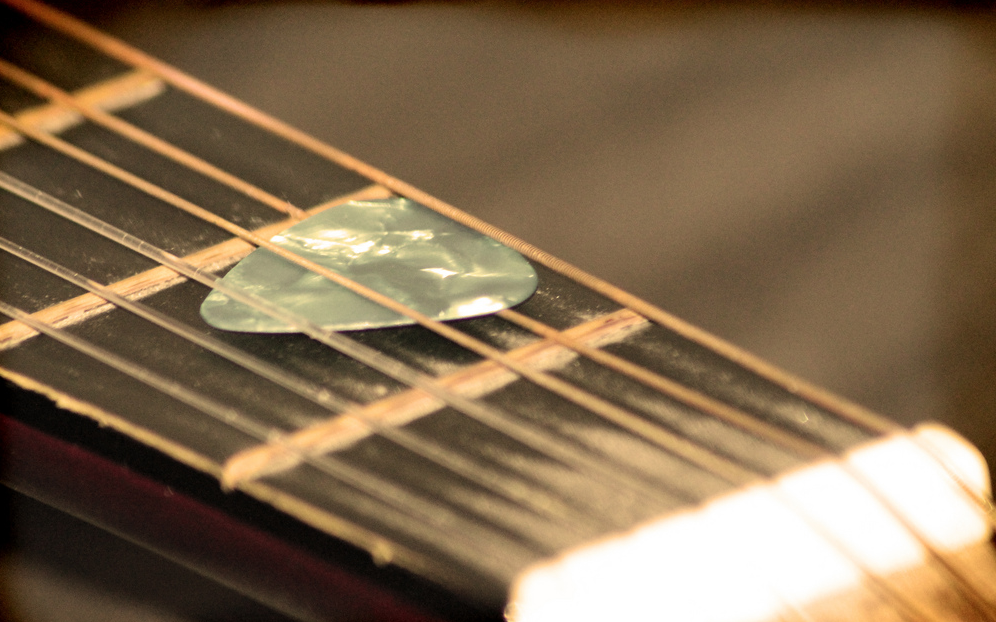
 An tool used to help pluck the strings of the guitar. Picks are made from various materials (plastic, nylon, shell, etc.) and come in different thicknesses and sizes. We suggest you try out different types of picks to find the shape and size that is comfortable for you. You should also load up, because picks tend to get lost very easily.
 Make a relaxed fist so you can see a one-inch circular hole in the middle.
 Balance the pick on your index finger so the tip points away from the palm of your hand.
 Lightly place your thumb on the pick to secure it against your index finger.
 While you strum, the pick should start away from the guitar and dip down into the strings, then raise back away from the guitar in a fluid arching motion. Slowly swing your arm from the elbow.
 Rotate your wrist in rhythm with the movement of your elbow. Rotate counter-clockwise while your arm is moving down and clockwise as it returns.
 Bend your wrist so it’s far from the guitar at the top and bottom of your arc, and close to the guitar in the middle.
 Flex your thumb slightly to angle your pick. This will stop the pick from getting caught on the strings and round out the sound when you strum.