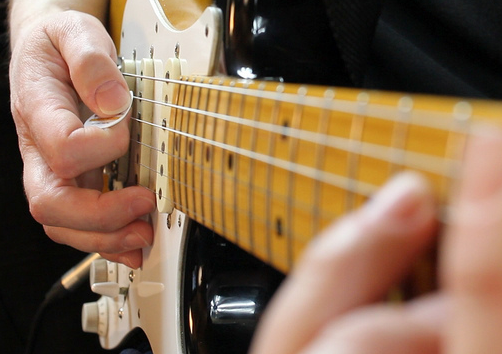
Welcome back. In the past few lessons we’ve been focusing on the left hand with different chords and chord techniques. In the next few lessons we’re going to focus in on the right hand and specifically on the subject of rhythm.
Rhythm can be a very big or intimidating subject, but in fact if you break it down to its components, it’s quite simple. It’s really a question of timing and speed. When do I play? How long does that thing last for until I play the next thing? That’s really all rhythm is. It doesn’t need to be this big subject of do I have good rhythm? Am I comfortable with rhythm?
In fact you might have great rhythm and you go to play your guitar and just the physical part of playing the instrument makes playing in rhythm difficult. So, it’s a skill like any other that you have to develop, that you have to work on, and that you can always improve upon.
So, let’s kind of look at an example here of what happens if we’re not playing with good rhythm. If I take a simple melody like Mary Had a Little Lamb, okay, and I change up the rhythms like this. I mean the things a hot mess. You don’t know what this is anymore.
Rhythm can totally change the song. You can work really hard on the song and not play it with good rhythm and people kind of don’t know what you’re trying to play. So rhythm is a critical part of music. Many say the most important thing. So let’s work on this one, and let’s start by learning some of the basic terms that are going to help us understand rhythm so that we can develop it.
The first thing we have to do is talk about the beat. What is the beat? The beat is kind of like the pulse. It’s a measurement of time that occurs regularly, almost without interruption. If you clap your hands to like your favorite song, odds are you’re clapping the beat.
So, I’m going to use my hands here, tapping on my guitar to demonstrate some of these principles. My left hand is going to be the beat, tapping it like that. Now, I’m going to count out loud while I tap, and I’m going to count in groups of four, like this, one, two, three, four. One, two, three, four. One, two, three, four, and so on. This is the most common grouping of beats in music. The technical term is four-four time or four-four rhythm, but it’s so common we often just refer to it as common time. So common time is groups of four beats.
And another term I can use is a bar or sometimes it’s called a measure. A bar is a term for a group of four beats. So if I were to tap out two bars of common time it would sound like, one, two, three, four, one, two, three, four. That was two bars. So this is the beat and how we’re going to organize it. It’s kind of like a reference point, right.
My right hand, let’s pretend this is like the right hand of my guitar, like if I were to strum. So if I were to strum once every four beats and let it ring out that would be called a whole note. So for example two, three, four. One, two, three, four. One, two, three, four. One two, three, four. One, two, three four. That was four bars and I was playing whole notes for every bar, okay. So it lasts for four counts. It lasts for the whole bar.
A half note lasts for two beats. So I can have two half notes in each bar. It’s going to sound like this, two, three, four. One, two, three, four. One, two, three, four. One, two, three, four. That was three bars in which I played half notes the whole way through. Also, if you practice this you want to resist the temptation to count them as one, two, one, two, one, two, one, two. Keep the counting one, two, three, four.
And the third type of note we want to talk about is the quarter note. The quarter note occurs every time you have a beat. So in other words it lasts for just one beat. Okay, so that would sound like this, two, three, four. One, two, three, four. One, two, three, four. That was two bars where I just played quarter notes.
Okay, so we’ve got the whole note, half note, quarter note. Whole note is four beats, two beats for the half note, and one beat for the quarter note. So some basic exercise you can do for strumming for example, is to take let’s say a D chord, and I’m going to strum these different rhythms, okay. Now, a good habit that a lot of teachers like, I certainly like them myself, is to use the left foot to tap. Obviously my hands are occupied so I can’t be tapping on something. And it’s probably not a good idea to tap too vigorously if you were to use your right hand. You don’t want the guitar flying all over the place.
So I’m going to tap with my left foot here and I’m going to practice. First I’ll play some whole notes, then we’ll do half notes and then quarters. Two, three, four. One, two, three, four. One, two, three, four. One, two, three, four. Now I’m going to go to half notes. One, two, three, four. One, two, three. Quarter notes, one, two, three, four. One, two, three. And then back to half notes, one, two, three. Whole notes, one, two, three, four. One, two, three, four.
So as you practice these, if you’re practicing tapping your foot, counting out loud, and playing, this stuff seems really simple, but it actually might be a little bit difficult. So have some patience with it. Remember to keep the beat even, that’s the most important part. And try practicing switching from different rhythms, make it totally random. Couple quarter notes, half note, a whole note. Challenge yourself to switch up the rhythm but keep the beat the same.
Okay, so once you’re comfortable with that, you’ll probably be ready for our next videos, in which we’re going to talk about using a metronome and developing some cool strum patterns and some good habits for developing your rhythm. We’ll see you next time.