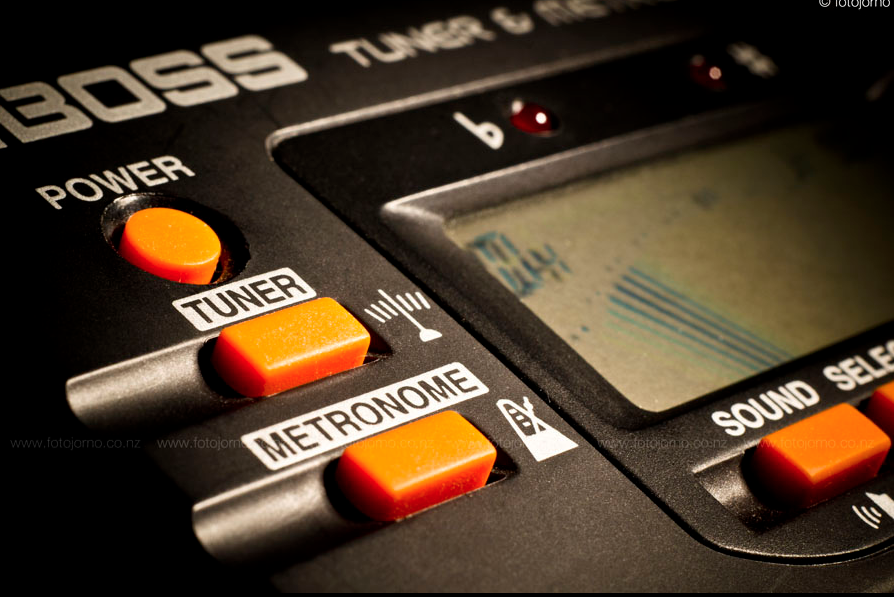
Welcome back. In the previous lesson we started to talk about rhythm and we learned some of the key terms so that we can talk about rhythm. Now, we also talked about tapping your foot and other things that you can do to kind of keep a strong beat. In this lesson we’re going to talk about using the metronome, which is a tool that kind of helps us keep a beat.
All right, let’s look at a common example of a metronome. This one basically has a switch to turn on and a dial that I can rotate that changes the speed of the click. Metronomes come in all different shapes and sizes these days. You can get ones that are entirely digital; you can still get the old ones that have an arm that swings back and forth in like a big wooden box. You can even download them for free on your smartphones. So, all sorts of options exist. I like this one; I like the sound of the click. Sometimes that click sound kind of sounds better to you than others.
So what we’re going to do here is put our metronome on 50. The numbers are the amount of beats per minute. So 50 is, I don’t know, it’s kind of like a medium, medium-slow beat, depending on your perspective. If these exercises feel too fast don’t be afraid to slow the metronome down.
All right, so, what we’re going to do here is play the major chords in the key of G to the metronome. If you need to refresh them, then go back and watch those videos. They’re there for you, but real quick it’s G, C and D. So we’re going to start out playing whole notes for each chord. So I’m also going to count out loud, so we can kind of keep track of all this stuff. One, two, three, four. One, two three, four. One, two, three, four. One, two, three, four. One, two, three, four.
So in the beginning since switching your chords is probably one of the more difficult skills, you might have to cut the chord short in order to set up the next chord, so you land on the beat in the correct place. So in other words I might hold the chord for like two beats and then spend the other two beats switching my fingers so I’m ready. That would sound like this, three, four. One, two, switching. One, two, three, four. One, two, three, four. One, two, three, four. And if you’re aware of how long it takes, this is a great way to track your progress. Now in a couple of weeks you might say, oh hey, I can hold it for three full beats, and I only need one beat to switch it.
So that was whole notes, using the three major chords in the key of G. Let’s do the same three chords but now we’re going to do half notes. So each chord only gets two beats or two clicks because remember the metronome is giving us the beat. So here we go, two, three, four. One, two, three, four. One, two, three, four. Again. One, two, three, four. One, two, three, four. So those are our half notes. That might feel pretty fast, you might want to slow the metronome down.
Now if we wanted to go for a real challenge we might try quarter notes, this means changing the chord for every beat. Let’s check that out. Three, four. One, two, three, four. One, two, three, four. So varying speed of the metronome is really important. Don’t be afraid to go super, super slow. Accuracy is the name of the game here.
Now, the last exercise we want to do is playing the spider exercise to the metronome. If we need a little refresher here, the spider exercise is the one where you start with your pointer finger on the first string, and you can really do any fret, find something that feels comfortable. And then you’re going to go finger by finger until you get to the end and then repeat it on the next string.
So the metronome is great here because when you start out you might do something like this, without the metronome. One, two, three, four. One, two, three, four. One, that little pause means we’re not playing in rhythm. So let’s check out this exercise. Metronome is still on 50 here. So now I’m spider exercise with the metronome. Three, four. One, two, three, four. One, two, three, four. One, two, three, four. One, two, three, four. One, two, three, four. One, two, three, four.
So a lot of people are very concerned with the metronome, like how fast can I use it because that’s going to be hard. In a lot of ways playing really slow is hard because there’s so much space between the beats, but it’s easy to be a little bit before the beat or a little bit after the beat, all right. If you’re playing too soon we say that you’re rushing. If you’re playing too late, meaning the beat goes by and then you hit your note, you’re dragging.
So what you want to practice when you work with the metronome is being right on the beat, having good accuracy. In the beginning this can be very frustrating. A lot of people buy a metronome, use it for a little bit and then it collects dust. That’s okay, but you want to develop your skills. So get that metronome out. Devote a little bit of your practice time to using it. When you become comfortable with it you might actually like to use it a lot. Some people practice all the time with a metronome, as a result they have great rhythm. And in the previous video you saw what happens if we start playing songs without very good rhythm.
So in the beginning it’s a little frustrating but hang in there and in a few weeks it will be like second nature to you. So we’ll see you in the next video.