We want to take a minute to summarize some of the various things that we’ve been saying in the past few lessons, in particular rhythm. Rhythm is super important in music, if you think about what we’re doing here when we play the guitar there’s kind of really three things. It’s wherever your left hand goes, your right hand, what strings it needs to pluck, and the timing of the two things. And timing is really what rhythm’s all about. If you practice a song really hard and the rhythm’s not there, it’s just never quite satisfying to listen to. On the other hand, all the time musicians make mistakes, but if they make them in rhythm sometimes the audience doesn’t even notice, and more often than not the sound of the song is still really grooving, and that’s what makes us kind of get into music, is that rhythm.
So just to review some of the basic vocabulary terms that we’re going to work with when we deal with rhythm, we have the whole note which lasts for four counts, we have the half note which lasts for two counts, the quarter note is just one count long, and the eighth note is a half of a beat, half of a count.
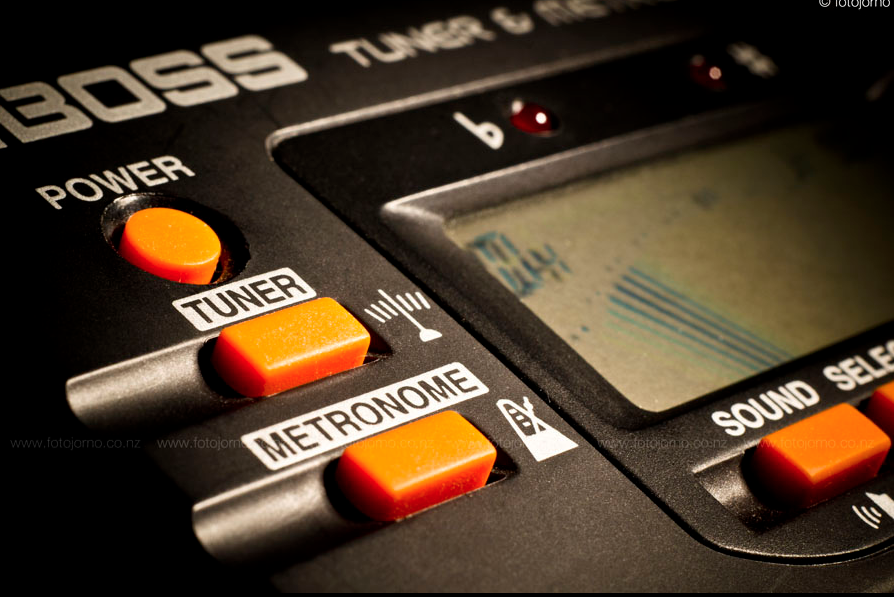
The metronome was a tool that we were using and the metronome really keeps us honest. The basic process of learning an instrument is kind of like dividing your brain in half, you’ve got the part of your brain that needs to process and understand and think, and then you’ve got this part of your brain that’s dealing with a completely physical thing, you know holding the stringed instrument, getting comfortable. My hand does what? It’s different part of the brain. What happens a lot of the times is when we work with a metronome, we think we’re playing in rhythm but the two parts of the brain are fighting and sometimes we get a little off and we might not even realize it. So working with a metronome is a great way to kind of train yourself to really stay in rhythm; stay disciplined with it.
Few other terms that we had dealt with, the backbeat. The backbeat was beats two and four, and that has a lot to do with the drums. There’s a snare drum which makes a really loud crack, and that tends to get played on beat two and four. So again, beat one is our anchor point, but a lot of times different beats get the accents.
We also talked about playing down on a down beat, and up on the up beat. So whenever the metronome clicks you’re going to be strumming down or plucking down if you’re doing notes. And up beats are in between the beats.
Counting out loud; really important to do. Tapping your foot, this is another thing. You can go overboard with it, you don’t want to be stomping, but this is a good exercise to do because if you think about when you’re tapping, you tap the floor when the metronome clicks, meaning when there’s a beat. That means that you have to lift your foot up to do it again, and what you tend to do is put it up in the up beat. So basically what you’re training your right hand to do is to move in step with your foot. Down with the down, up with the up, and that kind of gives two parts of your body the same task. Down, up, down, up, and that can be helpful.
All of this stuff definitely takes some patience and takes some time. What we’re really doing here when we learn to play is similar to like driving a car. If you’ve ever driven a car, in the beginning you’re thinking about turn signals and directions and brakes and maybe clutches and all this kind of stuff, and then ten years later you’re driving down the highway eating a sandwich, talking on your phone; and what you basically did was that processing part of your brain, you know, you process it all and put it in the subconscious and then you’re not even thinking about it anymore.
And when you see a musician up there, they’re rocking out, they’re having the time of their life, they don’t appear to be thinking, they’re not. At least not in the way they you do when you practice, and you really work things out, or you just learn the instrument.
So a lot of what we’re doing here is just kind of things that may not be so exciting but once you kind of get them into your subconscious you’re going to be able to start really expressing yourself. And that’s really what we’re trying to do here.
So have fun but discipline yourself to work on the things that you’re not so good at. If you devote maybe the first 10 – 15 minutes of your practice time to something that you know you need to work on, that’s a great use of your time. And then after that, have fun, that’s what it’s all about. So we’re going to see you in the next lesson, and keep working on it.